






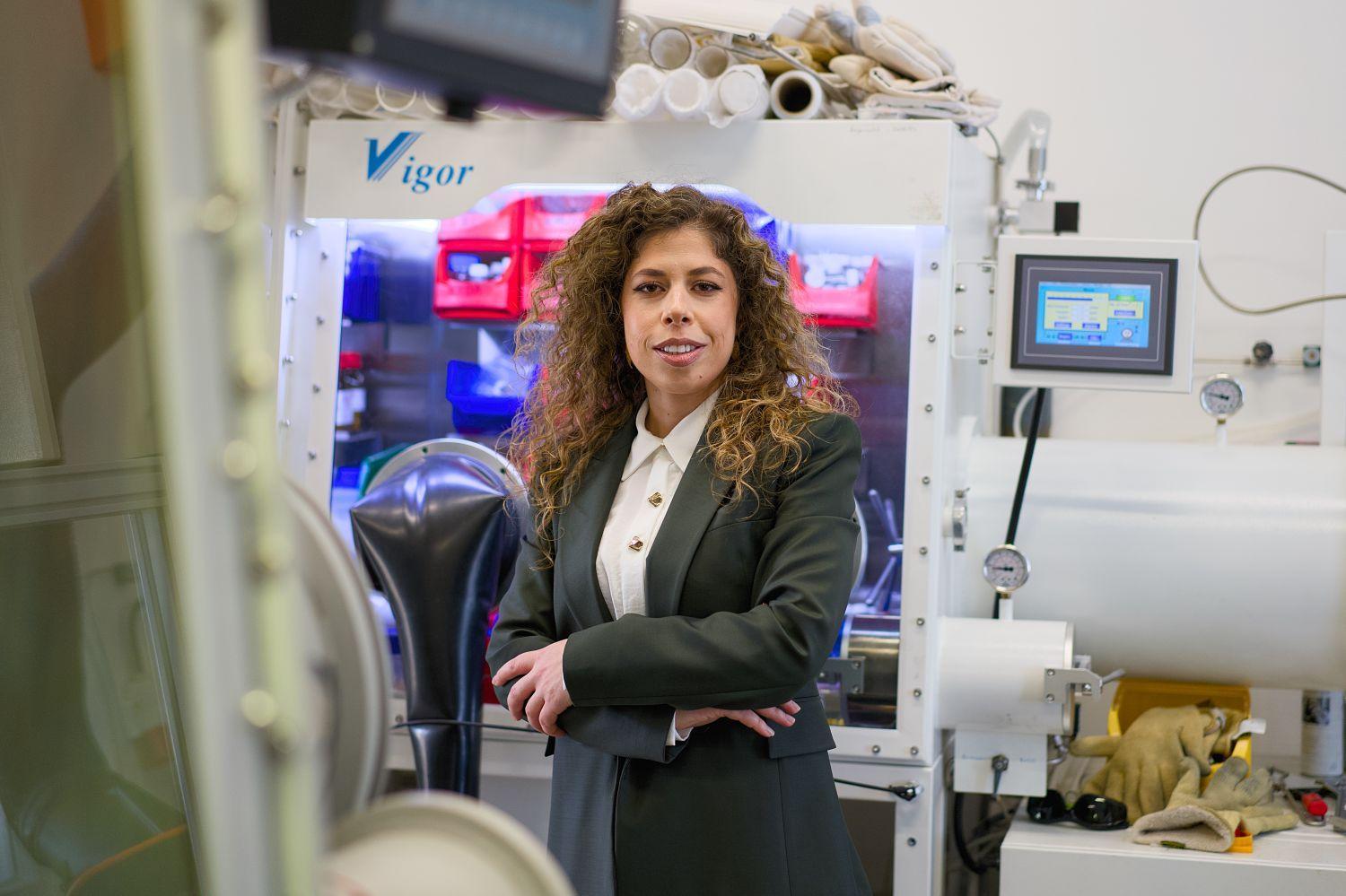
Filipa Oliveira succeeded in the prestigious GAČR competition
Congratulations on receiving the Junior STAR grant. What does this achievement mean to you and how will it influence your next steps?
Thank you. Receiving such a prestigious grant is a tremendous success. It gives me the opportunity to establish my own research group here at UCT Prague. The Junior STAR program supports talented young scientists in building teams and securing essential resources. This means I now have the foundation to fully dedicate myself to researching tubular MXenes and their applications in supercapacitors.
Why are tubular MXenes so innovative for energy storage?
MXenes are a family of 2D materials with a layered, “accordion-like” structure, known for their excellent electrical conductivity. Our innovation lies in creating them in a tubular morphology — combining high conductivity and redox activity with the outstanding ion-transport properties of tubular structures. Thanks to their open, hollow architecture, surface area increases, ion diffusion and charge transfer become faster. This could lead to more rapid and efficient supercapacitors, which are key to sustainable energy technologies.
How did your scientific interests lead you to this field?
Global challenges in green energy led me to explore materials that can improve energy storage. MXenes caught my attention because small changes in their composition and structure can dramatically affect their properties. I became curious about how different metallic elements in a tubular morphology influence the behavior of MXenes and how they can be optimized for practical applications.
What challenges have you encountered?
One of the main challenges is stability — MXenes oxidize quickly, which reduces their performance. Another issue is understanding how the synthesis conditions of both MXenes and their precursors (MAX phases) must be tuned to achieve and preserve the tubular morphology, since its formation mechanism differs from that of conventional MXenes. It was also challenging to describe the project clearly and persuasively in the grant proposal so that reviewers would see why it deserved support. However, thanks to mentorship and collaboration, I managed to overcome these obstacles.
What motivates you most about working at UCT Prague?
Support from colleagues and excellent technical infrastructure play a major role — it’s a great place to work. It’s also inspiring that I previously worked in Professor Sofer’s top-tier group focused on 2D materials; that experience shaped me significantly and led to this success.
How do you see your professional development in the future?
The grant will help me build my own team, acquire equipment, and develop collaborations. In the long term, I hope to make significant contributions to sustainable energy solutions and scientific progress both in the Czech Republic and internationally.
You are looking for new team members. What kind of students or researchers are you seeking?
We currently welcome enthusiastic master’s students, PhD candidates, and postdocs who are passionate about materials science and eager to push the boundaries of knowledge in MXenes and energy storage. If you enjoy curiosity-driven research and want to be part of a growing international team, we would be delighted to have you join us.